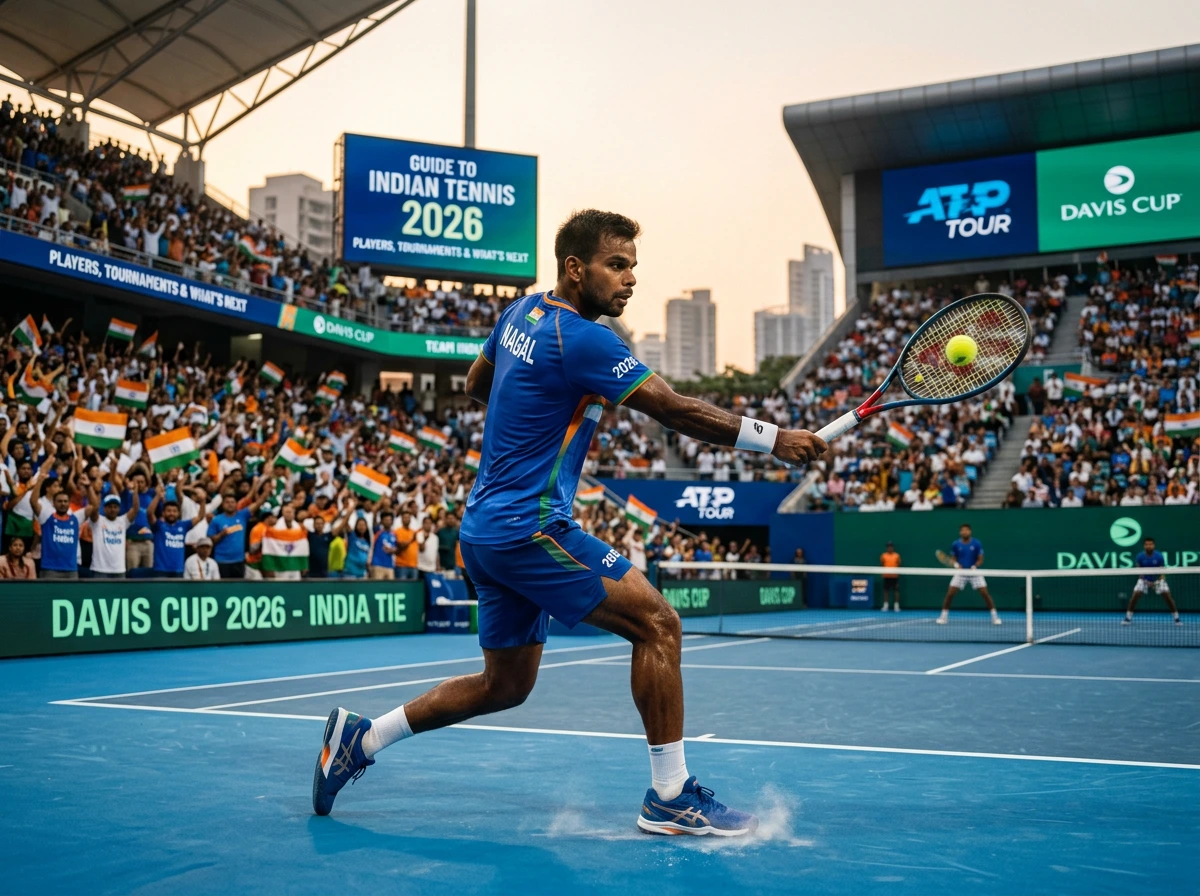
Davis Cup tennis occupies a unique space in the sport. In an era of individual achievement and personal branding, it remains the purest expression of team tennis — a competition where players represent their country, where the crowd becomes a factor, and where the collective matters more than the individual. India’s Davis Cup tie against the Netherlands on February 7-8, 2026, in Bengaluru delivered on every one of those promises. Over two days of drama, momentum swings, and relentless competitive intensity, India prevailed 3-2 in a tie that will be remembered as the moment Dhakshineswar Suresh announced himself as a Davis Cup force.
Day 1: A Split Start
The opening day followed a pattern familiar to anyone who has watched Indian Davis Cup ties in recent years: hope, tension, and a reminder that nothing comes easy in this format.
Nagal Stunned by Den Ouden
Sumit Nagal, India’s highest-ranked singles player and the team’s expected spearhead, took the court first against Guy Den Ouden. What followed was an uncomfortable afternoon for Indian fans. Den Ouden came out firing, racing through the opening set 6-0 with a display of aggressive, clean hitting that left Nagal looking flat and uncertain. It was the kind of start that sends a ripple of anxiety through a home crowd — the man you need most, struggling at the worst possible time.
To his credit, Nagal fought back in the second set. He found his range on the forehand, began competing on the Dutchman’s serve, and took the set 6-4 to level the match. For a moment, the momentum seemed to have turned. But Den Ouden proved the first set was no fluke. He regrouped in the third, broke Nagal’s serve at crucial moments, and closed out the match 6-3 to give the Netherlands a 1-0 lead.
It was a sobering result. Nagal’s Davis Cup record is generally strong, but on this day, Den Ouden simply played the better tennis. The loss put immediate pressure on the rest of the Indian squad — suddenly, every remaining rubber mattered.
Suresh Levels the Tie
Enter Dhakshineswar Suresh. If Nagal’s defeat created tension, Suresh’s performance in the second singles rubber dispelled it — at least temporarily. Facing Jasper de Jong, Suresh played with the composure and conviction of a player fully at ease in the Davis Cup arena.
The first set was tight but controlled. Suresh served well, moved efficiently, and constructed points with patience before accelerating when the opportunity arose. A 6-4 set win gave India the foundation they needed. The second set followed a similar trajectory — Suresh maintained his level, broke de Jong’s serve at the right moments, and closed out the set 7-5 to level the tie at 1-1.
It was exactly what India required: a clean, efficient victory from a player who showed no signs of nerves or doubt. Suresh’s performance sent the Bengaluru crowd home with renewed optimism heading into day two.
Day 2: Drama and Destiny
If day one set the stage, day two delivered the theatre. Three rubbers, three deciding sets, and a tie that went the full distance — it was Davis Cup tennis at its most gripping.
Bhambri and Suresh Deliver in Doubles
The doubles rubber is often where Davis Cup ties pivot, and this was no exception. India selected Yuki Bhambri alongside Suresh to face the experienced Dutch pairing of Sander Arends and David Pel. The match became an absorbing contest of nerve and execution.
The first set was a tense affair with neither team able to break serve. The tiebreak went to 7 points apiece before Bhambri and Suresh found an extra gear, taking it 7-6(7) in what felt like a mini-match within the match. The Dutch pair responded emphatically in the second set, winning 6-3 with aggressive net play that disrupted India’s rhythm. Everything hinged on the third set.
Again, the match went to a tiebreak. This time, the Indian pair was clinical. Suresh’s returning and Bhambri’s volleying combined to devastating effect as they raced through the breaker 7-1, sealing the rubber and giving India a 2-1 lead. The Bengaluru crowd erupted. India needed just one more win from the two remaining singles rubbers to clinch the tie.
De Jong Fights Back Against Nagal
The Dutch were not done. Jasper de Jong, who had lost to Suresh the previous day, produced a gutsy performance against Nagal in the fourth rubber. Nagal started strongly, taking the first set 7-5 with the kind of forehand-driven tennis that his supporters know he is capable of producing. It looked as though India might close out the tie in style.
But de Jong had other ideas. He adjusted his tactics, served with greater variety, and began taking the ball earlier to deny Nagal time on the forehand wing. The Dutchman leveled the match with a convincing 6-1 second set, then carried that momentum into the third, breaking Nagal early and holding firm to win 6-4.
The loss meant the tie was level at 2-2. India’s fate would be decided by a fifth rubber — the live fifth, the most pressure-filled scenario in all of team tennis. Everything rested on Dhakshineswar Suresh against Guy Den Ouden, the same player who had defeated Nagal the day before.
Suresh Seals the Deal
If there were nerves, Suresh did not show them. Playing in front of a Bengaluru crowd that understood exactly what was at stake, he produced a performance of remarkable maturity and controlled aggression. The first set was a masterclass in patient but purposeful tennis — Suresh moved Den Ouden around the court, stayed solid on serve, and broke at a critical juncture to take it 6-4.
The second set was tighter, as deciders in Davis Cup ties tend to be. Den Ouden raised his level, and neither player could find a break through regulation play. A tiebreak ensued, and Suresh rose to the occasion. At 4 points apiece on his mental scoreboard — in reality 7-6(4) — he closed out the rubber with a forehand winner that sent the stadium into raptures.
India had won 3-2. The crowd poured its emotion onto the court, and Suresh was mobbed by teammates who understood the significance of what he had just achieved.
Suresh: The Undeniable Hero
Three rubbers played, three rubbers won. Dhakshineswar Suresh’s contribution to this tie was extraordinary by any measure. He won both his singles matches in straight sets, then partnered Bhambri in a three-set doubles victory that proved decisive in the tie’s arithmetic. In a format that rewards consistency, depth, and mental fortitude, Suresh delivered on every count.
His performance raises his profile significantly. As outlined in our guide to Indian tennis in 2026, Indian men’s tennis has been searching for depth behind Nagal — a second singles player capable of winning rubbers against quality opposition on the biggest occasions. Suresh answered that question emphatically in Bengaluru.
The Bigger Picture
India’s victory means the team has now won three consecutive Davis Cup ties for the first time since 2013-14 — a run that underscores the progress Indian men’s tennis has made in recent years. This is no longer a team that relies on one individual to carry the load. The depth of options in singles, combined with a viable doubles pairing, gives India’s captain genuine tactical flexibility.
The reward for winning is a Round 2 tie against South Korea, scheduled for September 18-20, 2026. It will be another test of India’s team credentials, but after Bengaluru, there is genuine reason to believe this squad has the quality and the character to keep the run going.
What We Learned
This tie confirmed several truths about the current state of Indian Davis Cup tennis. Nagal remains the team’s highest-profile player, but his two defeats in Bengaluru were a reminder that even the best can have difficult days in this format. What matters is that the team around him was strong enough to compensate — and that is the definition of team depth.
Suresh’s emergence as a Davis Cup performer of the highest caliber gives India something they have not had in years: a genuine second pillar in singles. Bhambri’s presence in doubles adds experience and quality in a rubber that so often decides tight ties. Together, these elements form a team capable of competing with and beating quality opposition.
The Bengaluru crowd played their part too. Davis Cup home support is worth something tangible, and the Indian fans created an atmosphere that lifted their players in the most pressurized moments. When Suresh needed the crowd behind him in that fifth rubber, they delivered.
India 3, Netherlands 2. A tie that had everything — and a result that means something for the future of Indian men’s tennis.