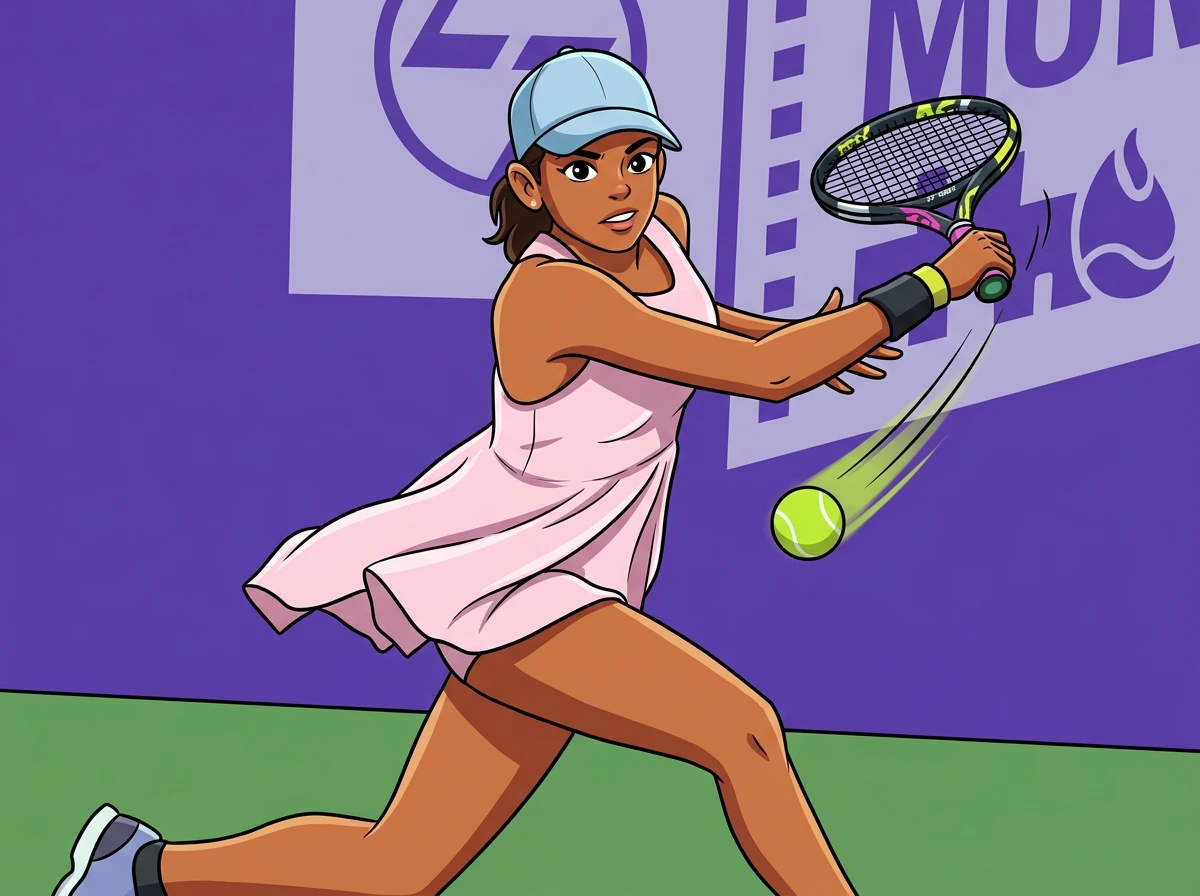
In a country where cricket dominates the sporting conversation, it takes something special for a young tennis player to cut through the noise. Maaya Rajeshwaran Iyer has done exactly that. Still in the junior ranks, she has already compiled a record of results that marks her as one of the most promising Indian tennis prospects in years — and possibly the player best equipped to carry Indian tennis forward into the next decade.
Early Development
Maaya’s tennis journey began in the academies that have become the backbone of Indian tennis development. From an early age, she showed the combination of athleticism, competitiveness, and technical aptitude that coaches look for in potential professionals.
What distinguished Maaya from her peers wasn’t just talent — it was the rate at which she improved. Each season brought noticeable advances in her game: a serve that gained pace and accuracy, groundstrokes that developed more weight and consistency, and a tactical understanding that grew more sophisticated with every tournament.
Her results on the domestic junior circuit were dominant enough to earn her selection for international ITF Junior events, where the real education begins. Playing against the best juniors from around the world provides a reality check that no amount of domestic success can replicate.
The International Stage
Maaya’s performances at ITF Junior events have been the most compelling evidence of her potential. The international junior circuit is fiercely competitive — players from tennis powerhouses like France, the United States, and Australia arrive with extensive coaching support, superior training facilities, and deep competitive experience.
Against this backdrop, Maaya has more than held her own. Her results at Grade A and Grade 1 events — the highest levels of junior tennis below the Junior Grand Slams — have demonstrated that she can compete with the world’s best players her age.
Her game translates well to the international stage because it’s built on solid fundamentals rather than tricks or gimmicks. The flat, penetrating groundstrokes that overwhelm domestic opponents remain effective against international competition, though the margins become finer and the physical demands increase significantly.
Playing Style
Maaya plays an aggressive baseline game that reflects the modern template for women’s tennis. Her forehand is her primary weapon — hit with early timing and genuine pace, it can dictate rallies from the first ball. The ability to take the ball on the rise and redirect it with power is a skill that many professional players struggle to master, and Maaya has shown it consistently.
Her backhand, struck two-handed, provides reliable depth and the occasional winner down the line. It’s not yet the equal of her forehand as a weapon, but it’s sound enough that opponents can’t build a strategy around attacking it exclusively.
At the net, Maaya shows the comfort and instinct that suggest she could develop into a versatile player rather than a pure baseliner. Her volleys are clean, her overhead is confident, and she moves forward with purpose rather than hesitation. In an era where net play is making a comeback in women’s tennis, this versatility could prove valuable.
Her serve is an area of ongoing development. The biomechanics are good — a fluid motion that generates decent pace — but adding consistent power and variety to the serve will be crucial as she transitions to professional tennis, where holding serve becomes non-negotiable.
The Mental Game
Junior tennis is as much a mental battle as a physical one. Players at this age are still developing emotionally, and the pressures of international competition — travel, time zones, unfamiliar opponents, and the constant evaluation by coaches and federations — can overwhelm even the most talented players.
Maaya’s temperament on court is one of her strongest assets. She competes with visible intensity but rarely lets frustration derail her focus. The ability to reset after losing a point — or a set — and refocus on the next challenge is a hallmark of players who successfully make the transition from juniors to professionals.
Her match management is also advanced for her age. Rather than relying on a single gear, she’s shown the ability to adjust tactics mid-match, changing the pace and direction of her shots to exploit opponents’ weaknesses. This adaptability is a sign of genuine tennis intelligence.
The Transition Challenge
The gap between junior tennis and the professional tour is the most treacherous passage in a young player’s career. History is littered with brilliant juniors who never fulfilled their potential as professionals — the reasons range from physical development issues to burnout to the sheer difficulty of competing against grown adults while still a teenager.
For Maaya, the transition will require careful management. The temptation to rush onto the professional circuit must be balanced against the need to continue developing physically and technically. Many successful professionals — including several current top-20 players — spent their late teenage years mixing junior and low-level professional events, gradually increasing the competitive level as their games matured.
The ITF World Tennis Tour, with its tiered structure of W15, W25, W50, and W100 events, provides a natural pathway. Starting at the lower levels and progressively moving up as ranking and results allow is the proven route for most players who lack the resources to parachute directly into WTA events.
What India Needs From Maaya
Indian tennis needs Maaya Rajeshwaran Iyer to fulfill her potential — not because the weight of a nation should rest on a teenager’s shoulders, but because successful role models create the conditions for more success. Every Indian player who competes credibly on the international stage makes it easier for the next one to follow.
Maaya’s success would also validate the development pathways that Indian tennis has been building. If a player can emerge from the Indian academy system, develop through domestic and international junior competition, and transition successfully to the professional tour, it proves the system works — and encourages further investment.
Looking Forward
Maaya Rajeshwaran Iyer has all the ingredients: the talent, the temperament, the work ethic, and the competitive drive. The question — as it always is with young athletes — is whether the ingredients will come together at the right time and in the right proportions.
The next two years will be critical. As she navigates the late junior and early professional stages of her career, the decisions made by Maaya and her team — about scheduling, coaching, physical development, and competitive level — will shape her trajectory.
For Indian tennis fans, she represents something precious: genuine, evidence-based hope. Not hope built on hype or wishful thinking, but hope grounded in results, in observable improvement, and in the kind of competitive fire that separates those who make it from those who don’t.
Watch this space.