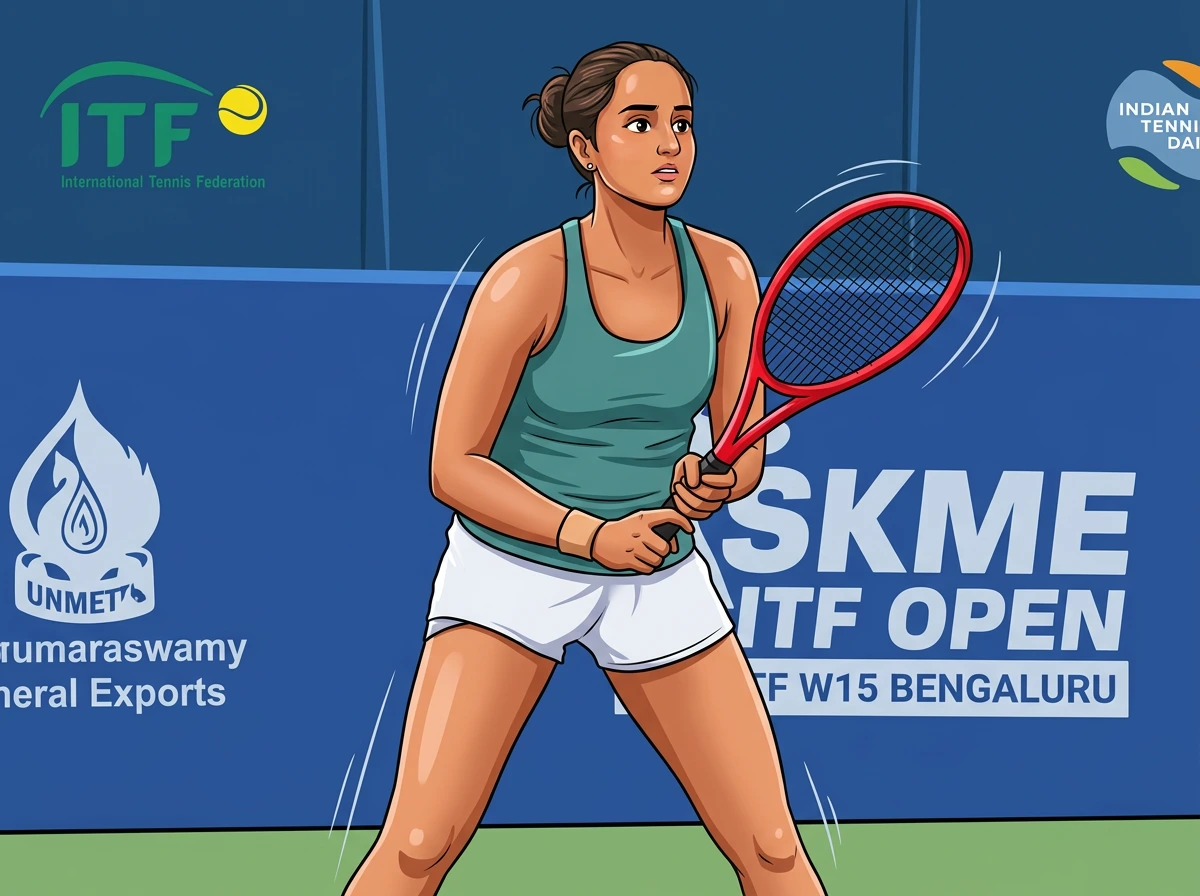
When Vaishnavi Adkar stepped onto the court at the W100 Bengaluru, she carried with her not just her own ambitions but the weight of expectation that comes with being identified as Indian women’s tennis’s next great hope. What followed was a performance that justified every bit of that expectation — and announced to the tennis world that India’s women’s game has found its next standard-bearer.
The Tournament Run
Adkar’s path through the draw was emphatic. From the early rounds, where she dispatched experienced ITF campaigners with clinical efficiency, to the later stages where she raised her level against higher-ranked opponents, the teenager displayed a maturity that belied her age.
Her serve, which has been a consistent weapon throughout her junior career, proved equally effective against professional opponents. The ability to hold serve comfortably against seasoned players removed the pressure from her return games, allowing her to play freely and aggressively on her opponent’s service games.
But it was her movement that truly impressed observers. Modern women’s tennis demands exceptional court coverage, and Adkar showed she possesses the footwork and anticipation to compete at the highest levels. Her ability to transition from defense to offense — absorbing pace and redirecting it with interest — is a skill that takes many players years to develop.
What Makes Adkar Special
Every generation of Indian tennis produces players with talent. What separates those who break through from those who don’t is often a combination of mental fortitude, physical durability, and the ability to perform when it matters most.
Adkar’s composure during high-pressure moments at the W100 was striking. Tight sets that could have gone either way were decided by her willingness to go for her shots rather than retreat into passive play. This aggressive mindset — the refusal to play not to lose — is what separates good players from potential champions.
Her technical game is built on modern principles: a two-handed backhand that generates heavy topspin, a forehand that can be both a rally weapon and a finishing shot, and a serve that combines accuracy with enough pace to keep opponents honest. There are no obvious weaknesses to exploit, which is itself a testament to the quality of her development.
The Sania Mirza Comparison
It’s impossible to discuss a breakthrough Indian women’s tennis player without invoking Sania Mirza’s name. Mirza’s impact on Indian tennis was seismic — she didn’t just compete at the highest levels, she changed what Indian women believed was possible in the sport.
Adkar has been careful to forge her own identity, and rightly so. While Mirza’s game was built around explosive power and fearless shot-making, Adkar’s game is perhaps more well-rounded, reflecting the evolution of women’s tennis over the past decade. Today’s game demands more versatility, more fitness, and more tactical awareness than ever before.
The comparison that matters isn’t stylistic but aspirational. Mirza proved that an Indian woman could compete with the best in the world. Adkar has the tools to build on that foundation and potentially go further.
The Path Forward
A W100 title is a significant achievement, but Adkar and her team will know it’s just the beginning. The gap between the ITF circuit and the WTA Tour is real, and bridging it requires sustained excellence over months and years, not just one tournament.
The immediate priority will be accumulating enough ranking points to enter WTA 250 events directly, reducing the need to grind through qualifying rounds. Each main draw appearance at WTA level provides invaluable experience — the quality of opponents, the pace of play, and the intensity of competition all increase sharply.
Physically, the transition from junior and ITF tennis to the WTA Tour is demanding. The calendar is relentless, the travel is grueling, and the margin for error shrinks as the level of competition rises. Adkar’s team will need to manage her schedule carefully, balancing the need for competitive match play against the risk of burnout and injury.
What It Means for Indian Women’s Tennis
Adkar’s breakthrough doesn’t exist in isolation. It’s part of a broader trend that sees Indian women competing more regularly and more successfully on the international circuit. Ankita Raina’s sustained presence on the ITF circuit, combined with the emergence of younger players in the junior ranks, suggests that Indian women’s tennis is building genuine depth.
This matters because depth creates sustainability. When one player carries an entire country’s hopes, the pressure can be overwhelming and the impact of injury or loss of form devastating. When multiple players are competing internationally, the ecosystem becomes self-reinforcing — younger players have role models to follow, and the national team (Billie Jean King Cup) becomes more competitive.
The Support System
Behind every breakthrough performance is a support system that made it possible. Indian tennis has historically struggled with the infrastructure needed to develop world-class players — coaching quality, training facilities, sports science, and financial support have all been limiting factors.
Adkar’s development suggests that at least some of these gaps are closing. The combination of domestic academy training, international exposure through ITF events, and the mentorship of experienced Indian tennis figures has created a pathway that works.
The challenge now is ensuring that this pathway is available to more than just a handful of talented players. If Indian tennis can institutionalize the development model that produced Adkar, the impact on the women’s game could be transformational.
Looking Ahead
Vaishnavi Adkar’s W100 Bengaluru breakthrough was a statement. It said that Indian women’s tennis has a future that extends beyond nostalgia for Sania Mirza’s era. It said that the investment in junior development is paying dividends. And it said that the tennis world should take notice.
The journey from W100 champion to established WTA player is long and uncertain, but Adkar has shown she has the game, the temperament, and the ambition to make it. Indian tennis fans have a new player to follow, and a new reason to believe.